The weird encounter

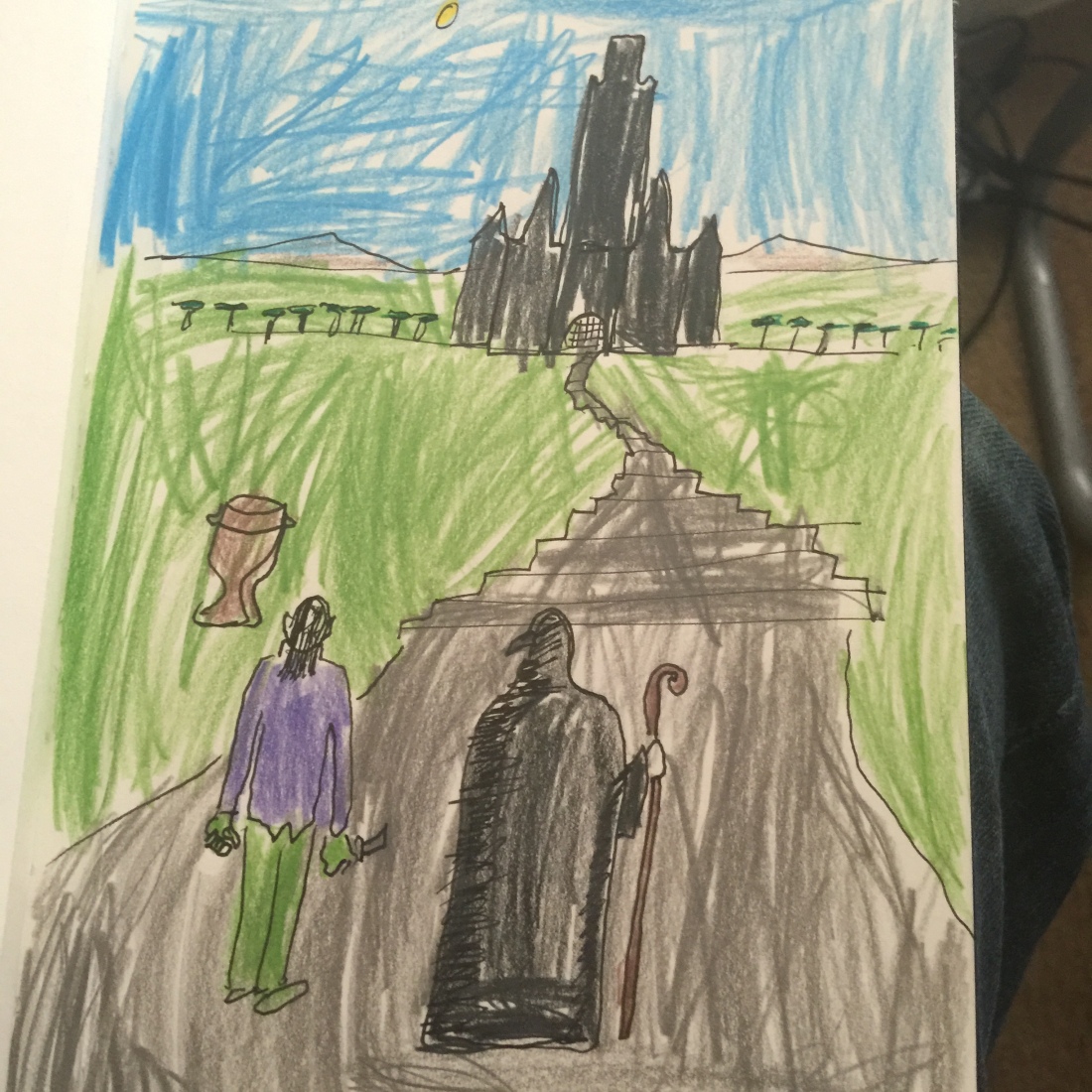
Poxig brushed back the hair from his eyes. He had always wanted to become a wayward wanderer, and now he was able to do so.

It was time to say goodbye to Janquis for now and head to his mother’s house, and this time is was for an extended goodbye. He was now going with Janquis to Marginalia, and he would not return for some time, if ever.

Life would become more fantastical and wildly erratic for this young elf, especially because that time had passed from young adulthood to adult, & now he would see new things and experiment on a level that he had never known.

There were gifts from his mother that he did not want to forget. One of them was the Orb which had once belonged to his father. This was the Orb that the prophecy had talked about, & he had realized how important it was to retain this knowledge. If leaked out, it could cause the imps to summon dark-magic that would overthrow the delicate balance of Illyria.

Once he had arrived at Excelsior, he stayed at his mother’s cottage for a little while, & then moved on towards castle Marginalia. There he would gain an audience to king Charles I, and receive his mission. It was a long slow trudge to the emissary Seljuk, who was the first person to visit on his journey.

In fact, emissary Seljuk, or Er. Seljuk as he was known, was a friend of his father’s, and had been a trusted adviser of the family for many years. He came to the man’s cottage and knocked on the door. In fact, a nameless beggar prevented him from getting to the door. He was asleep on the doorstep.

“This is Emissary Seljuk’s house! Who goes there?” he asked.

“It is me, Poxig, ” said the young elf.

“Er. Seljuk doesn’t like mendicants!” he exclaimed.

“What makes you think I am as such?” asked Poxig.

“I am the guardian of his house,” he said.

“Why do you look like a beggar?” asked Poxig.

“Obviously, to repel the beggars,” he replied.

“And so?”

“You didn’t even ask my name or pay me respect, even though I am a  surrogate for an emissary.”

“Pardon me, what is your name?”

“Guess,” chimed the beggar-man.

“Rumplestiltskin.” said Poxig.

The beggar chortled.

Suddenly the door opened to the house, and none other than Emissary Seljuk emerged.
“What’s all this racket?” asked Er. Seljuk.

“Oh, dear sir, pardon my intrusion. I am looking for Er. Seljuk,” intoned Poxig.

“Is Sheldon bothering you? I told him not to be rude to visitors,” said Er. Seljuk.

At this, Sheldon turned into a falcon and flew away.IMG_0551


The search

The two neophytes wandered to the foot of the statue outside the great manse. Inside, there was surely the remains of the undead creature. Poxig felt trepidation, but in all honesty, he was glad to have his new friend Lakfi by his side.

“The first rule of black magic is that you must never underestimate the power of the opponent you are facing. The best bet is to overwhelm him with superior force at the beginning, and not give him a chance to retaliate,” said Lakfi.

“That would be fine, but we’re not trying to kill this agent of darkness. We must convince him to come back to his lost love, and so to save his soul. Somewhere in the soul of the vampire, there is Carl Conrad,” said Poxig.

They approached the castle and knocked on the solid oak door. The lion’s head knocker showed them that this man was one of wealth and taste. There was no answer. They knocked a second time, and suddenly, a man dressed in a suit and tie opened the door.

“May I help you?” asked the butler.

“We’re trying to locate Carl Conrad,” said Poxig.

“I’m sorry, but the master of the house has been deceased for three years,” said the butler.

“We happen to know that’s not true!” said Lakfi.

“I’m quite certain of it,” the butler said. “but if you’d like to come in and look around, you’re more than welcome to do so.”

Poxig and Lakfi went in. But as soon as Poxig had his back turned looking at an old suit of armor in the foyer, the butler accosted him and tried to bite his neck. Lakfi blasted him into a corner with a rush of fire magic, and knocked him out cold.

“You can’t trust anybody here!” said Lakfi. “They’re all vampires. They aim to kill.”

“I owe you one,” Poxig said. He knew that without Lakfi, he would have surely met his doom.

The two friends ventured into the basement, where there was a sepulchre. In the gloaming, there was a head stone. “Carl Conrad (872-902),” it read.

“So maybe the butler was right!” Poxig said. “But I’m sure that Conrad awakens at night to feast on human blood.”

“Can you be sure that Dr. Unne is telling the truth?” Lakfi questioned. “Perhaps he is not the friend you thought he was.”

Poxig had a small doubt. But then he remembered what his mother Eliana had taught him about dark magic. It was always to see the pessimistic side of things, which eventually led to a spiral of negativity.

“No, let’s search the house. Dusk has almost arrived.”

The two friends went into the manse and searched the corridors. Around the halls were old paintings, sacred manuscripts, and suits of armor. They could not contain their expectation. Someone was keeping up this place, for it had not fallen in disrepair. They knocked on the tower door.

“Hello?” Poxig shouted. “Anyone here?”

“Come in,” said a voice.

Right in front of them in a fauteuil sat a man who was impeccably dressed. He was sitting by a roaring fire, and smoking a pipe.

“Lane must have let you in,” said the man. “Who do I have the pleasure of meeting this evening?”

“I’m sorry sir, but we’re looking for Carl Conrad,” Lakfi blurted out.

“Well, you are speaking to him,” retorted Conrad.2016-04-29 15.18.07


The new friendship

Poxig continued to the hallowed Hall of black arts,  where mages of every stripe would go to learn the craft. He realized that his grasp of Latin was small, and therefore, his chance of learning any magic would be nil. But his story was too good to keep to himself. He had to reunite the lost widow Conrad to her ancient lover, and so perhaps, save his soul.

He approached the front counter, where concoctions of magic potions were strewn about. There were journeyman mages everywhere saying incantations of an inscrutable tongue. He nodded at the strangely dressed attendant, who wore a coat of rainbow colors.

“May I help you, sir?” he asked.

“Yes, I am trying to find a black magician in order to accompany me on my way. I am going to a dark circle where only dark magicians can navigate the terrain. Perhaps, you can tell me who is selling their services, and I will choose from one,” uttered Poxig.

“Yes, yes.” At that moment he heard some shouting in the back.

“Κοσμος, Κοσμον, Κοσμου,” the strange man chanted.

Poxig did not know it, but he was practicing his Greek declensions. Poxig was very curious what this strange language might have to do with his question. “Who is that?” asked Poxig.

“That is Lakfi,” said the attendant. He’s the worst student here, but his price is very small.

“Will you call him for me?” asked Poxig.

The attendant called for Lakfi, who appeared in a disheveled garment,  without any formality. He wore a giant  wizard’s cap, although it was apparent by his coarse appearance that he was not a master, but merely a moonlighting mage.

“What were you talking about back there?” asked Poxig.

“Oh, hi. Yes, that was the word ‘cosmos’, which is the Greek word for ‘world.’ I was expressing my general frustration with the world,” chimed Lakfi.

“Oh?” said Poxig.

“Well, injustice  seems to come more often than I would like. I should be in a wizard’s guild by now, but I am stuck in Melmond,” he replied.

“Well, it’s funny that you should ask. I am looking for a mage to accompany to the castle of a well known practitioner of the black arts. Perhaps, you fit the description of someone who might be able to help me.”

“That depends on how much you are willing to pay,” Lakfi responded.

As Poxig could not afford to hire him, he tried a different approach. “I am a light warrior. I wish to have someone to aid me in pursuit of the reason of the corruption of earth.”

“A light warrior!” exclaimed Lakfi. “Then, perhaps I can learn something from you! I am always open to learning things. But I must admit, if there is no chance of success.”

“If we find the cause of the earth’s rot,” interrupted Poxig, ” then, you can be sure there will be a reward in the land where I am from, Marginalia.”

“Ha! Everyone knows there are no elves in Marginalia!” retorted Lakfi.

“My father was held captive in the wars of religion. He converted and changed his name.”

“I see. Well, that makes sense.”

“What do you say about this idea?” asked Poxig.

“Well, I don’t very much think I can help you, but a chance to learn something from a light warrior seems reason enough. I will help you on one condition. You must answer a riddle. What is the opposite of happiness?” asked the black mage.

Poxig thought for a while and admitted he did not know. He guessed, “The question is flawed. You must claim to be happy to know its opposite.”

“Clever! We’ll leave it at that! I will join this enterprise.”

The two associates left the hall of black arts in a peal of laughter. It was likely that they would become friends, even if they never accomplished the mission.  Poxig was glad at least that he would have some insight into black magic, which would be indispensable if they were to return the vampire to its original state.2016-04-29 15.17.46


Why Greek?

Greek tablet

Some of you might be wondering why the story has Classical Greek in it. In fact, this kind of Greek is used in Homer’s IliadOdyssey, a testament to the enduring quality of this language.

Greek was the lingua franca of the 1st century A.D. Due to the conquests of Alexander the Great, the language was the means by which different cultures could communicate, much like English is today.

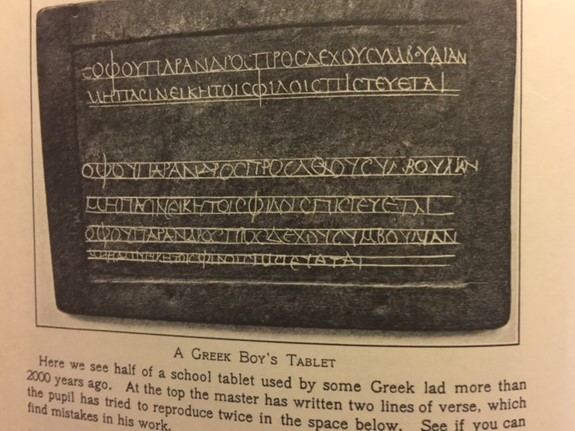
However, many of our writing conventions had not yet been established.  This tablet shows that in ancient Greece, letters were often written  without spaces in between words. This is primarily because nothing was written that was not meant to be read aloud. Principally, the reader would be able to sort out the sounds and then speak the words aloud.

No punctuation was put into words until reading silently became important, which developed for English in Victorian England. Of course, this happened at different dates for different cultures.

I consider Classical and its later counterpart Koiné Greek ( the language of the New Testament) to be a magical language that has since been forgotten by a generation of English speakers who have forgotten in large part how important this culture has been in shaping our own.

My current Greek textbook calls Christianity the “last great achievement of classical civilization.” I think this is true in large part. Although this language is very hard for young people to learn, I do think it is possible. My son has learned the Greek alphabet by replacing the Greek characters in the ‘abc’ song.

The love lost ( part 2)

Dr. Unne and Poxig traipsed up to the dilapidated old cottage at the end of Melmond. There were feral cats around everywhere, and suzukibs in the tree. They knocked on the wooden oak door thrice.

“Is anyone home?” asked Poxig.

“No one could be sure.” said Dr. Unne. “Milly! Open the door!”

“Maybe she is out,” said Poxig.

“It is not possible, since the old widow never leaves.”

They waited for what seemed like 20 minutes, and then Dr. Unne was convinced that there was something wrong. They decided to break down the door. They found a sturdy tree trunk from a fallen one. Then, they began to slam into the door.

“Heave, ho!” exclaimed Poxig.

The door was not bolted, and  easily gave way. Inside they saw Milly Conrad, who was lying motionless in her bed. Dr. Unne approached her cautiously, and then checked her pulse. There were no vital signs.

“She’s gone,” said Dr. Unne. “It must have been natural causes.”

But nearby, Poxig spotted a note on the bureau. It was written in green ink and stamped with a red stamp. Here were the contents of the note:

“To whom it may concern:

I could not go on living without Carl. I decided to take arsenic and end it. But I want to say one thing. Carl is not dead. He simply was transformed into an evil being by the dark orc-wizard Darxon. He is now known as the vampire of Melmond. He had tried many times to take me with him to his lair in the church vault, but I would not go, for the man I loved was gone. I tried to rehabilitate him but failed. But remember the man he used to be. Tell Carl that I love him, and he may yet be saved from the horrible fate that awaits the wicked. Please save my Carl and bring him back to life, so that I may enjoy eternity with him in the hereafter, where I am now.

Milly Conrad”

“So that’s how he became  the vampire who terrorized this town for so many years,” said Dr. Unne. ” I never knew the truth.”

“Well,  now I know what we must do. We must try to find Carl in the vampire and restore him back to his old self,” said Poxig

“You must go alone,” replied Dr. Unne. ” I am no warrior, and I am no match for the vampire’s evil magic.” But Dr. Unne handed him a pendant, that was blue and gold with a Latin cross on it.

“This will protect you from the vampire’s fangs,” said Dr. Unne. “But tread carefully, the vampire has a way a dazzling his enemies with his dark power. He may convince you to give him the pendant, and then you will surely perish.”

“I will take your advice to heart,” Poxig thought. But he knew that he could not face the wicked magic alone. He would need someone who was able to understand the vampire’s weakness. And that was the town’s vendor of black magic, whose name was Lakfi. He went to the purveyor of magic just outside Melmond.2016-04-29 15.18.07

The lost love

“Nauta puellam amat.”

Poxig read from the stone obelisk that was at the entrance to the town of Melmond. It must have been some kind of a gravestone. Melmond was known for its lugubrious atmosphere. Broken gravestones littered the town, which was almost deserted.

“Go to the lowlands,” shouted a shadowy figure. “Necessary items will have to be jettisoned.”

“What?” Poxig retorted. “Who’s there?”

But the figure disappeared into the woods.

There was no telling what Poxig would have to do in order to make the situation bearable.  The wizard who dwelt in the land would help him through the next item on his journey. Perhaps like this lonely voice from the wood, he would find the purpose of his lowly journey. Perhaps he would be like the forgotten sailor who made this stone to his lost love.

Poxig wondered what the shadowy figure could have meant. It was not altogether obvious. He had heard from a villager in these parts that a vampire had been terrorizing the town. As the prophecy had read, “the earth begins to rot,” he realized that their town was in grave danger.

Perhaps Poxig, with the help of a hero of old, would be able to vanquish this host of night. But he knew that his guitar would not be of much use in destroying the vampire. In order to do this, he would have to find a stake to drive through the heart of this unholy beast. But he knew he could not do it alone…

He came upon a house with a thatched roof with the letters ‘DR UNNE’ on them.

“This must be the residence of Dr. Unne, the linguist!” exclaimed Poxig. “Maybe he can help me end this misery of Melmond for good!”

He knocked on the door, which opened. A man of studious appearance and thick glasses appeared. He wore a white lab coat and had bits of papers shoved in his coat.

“Dr. Unne, I presume…” said Poxig.

“Yes,” he replied. “And you are…”

“I am Poxig, the elf, from Marginalia.”

“No elves live in Marginalia.” he said. “Good day.”

“No wait!” he stopped the door from closing shut. “Can you help me translate something?”

“What is it? That is my scientific speciality.”

“It is a phrase on an obelisk near the entrance to Melmond.”

“What does it say?” Unne asked.

“Nauta puellam amat.”

“This is a Latin phrase from our ancestors,” the doctor replied. “Our alphabet is closely related to theirs. The phrase means ‘The sailor loves the girl.’ It is the sailor from Melmond by the name of Carl Conrad, who fought in the wars of religion and died to defend our religion from the apostasy of the elves.”

“Thank you, sir,” replied Poxig. “But may I ask just one more thing?”

“Go ahead.”

“Does the girl still live in Melmond?” Poxig asked.

“She does. She’s an old woman that lives down the road by the name of Milly.”

“Thank you sir.”

“Let me ask you one question, Mr. Poxig,” replied Dr. Unne. “What brings you to this desolate town?”

“I am on a quest to become one of the light warriors. One of the stages of my quest is to find the cause behind the earth’s rot.”

“A noble cause!” he said. ” You know that it is connected to the vampire that terrorizes the town, looking for fresh human blood when the sun goes down.”

“I had hoped that Milly might be able to give me some information about how the town used to be before the vampire’s curse settled here. Then, I might be able to find a weakness.”

Dr. Unne grabbed his overcoat. “Let me go with you. Perhaps together, we can end this evil, and restore the earth.”

The two new friends walked down the road to Milly Conrad’s place.

IMG_0542 (2)


Comprehensible input?

I just read an article in Language magazine that argued for Stephen Krashen’s theory of comprehensible input. (For you language teachers out there, it is often referred to as ‘n+1’) While nobody would disagree with Krashen’s basic premise, (given that Krashen has rock-star status in ESL and Applied Linguistics) the article was immensely frustrating. It suggested that pleasure reading, more than any other skill, provides comprehensible input to a larger degree than anything else.

Anyone who has been teaching ESL for more than 5 minutes knows that to get your students to ‘pleasure read’ in a second language is about as easy as pulling a tooth from a crocodile’s mouth. Anyone knows that the slightest bit of text that is ‘read in class’ (not pleasure reading) has to be scaffolded with an immense amount of vocabulary building. The one thing that ESL learners are unable to do is pleasure reading.

This is why I wrote in an earlier entry that teachers must make methods ‘work.’ Most of the research does not actually boil down to useable stuff in the classroom. For this reason, teachers constantly have to be adapting their material to the realities in the classroom. The only research based trope that I’ve been able to use in the classroom is Diane Larsen-Freeman’s ‘Form-Meaning-Use’ chart in the “Apple book” edited by Marianne Celce-Murcia.

It makes me furious that this sort of stuff gets published in major magazines! ‘Pleasure reading’ is what native speakers can do with their L1, nobody can read for pleasure in an L2 that’s being acquired. The statement “all horses are purple  with blue polka dots” makes more sense than the article by this anonymous author.

Ah well! ESL is like a blue and purple polka dotted beast! You can claim to understand it, but then we might ask how many articles you have published in TESOL Quarterly. None? Oh, that’s what I thought. So you’re not a researcher. I hope you’re a good teacher.blue and purple horse

Poxig and the evil orc

He  moved slowly down the riverbank, penknife in hand and his guitar strapped to his back. He had just lost his friend Jancuis in the evil swamp, and all around him he heard:

‘Ο Ποταμος, ‘Ο Ποταμος.

The talking trees were chanting again, and this time it was the Greek word for “river”. He had heard of a huge beast called the ‘hippo-potamus’, which meant ‘horse of the river.’ This beast had huge jaws and was very dangerous, but this was the least of his worries.

Poxig had yet to find his father’s friend’s house, Emissary Seljuk, who had known him before he disappeared. If he made it through the forest, he would be able to at least get to that small hamlet in the woods called Renfro, where the Emissary lived.

“These woods are spooky,”  he said. “I had better get out my guitar and start singing, and that way, the imps would be scared away. If I run into an orc, there’s no chance that I could defeat him. If only I had not lost Jancuis in the forest!”

The sun was setting as he got out his guitar and began to sing to the elven god, Releven.

‘O Releven, Releven,

You are the shining star

Bring us back to our senses,

Show us eternity from afar.’

As he began singing, the talking trees seemed to sing along with him, as if he were bringing life back to the forest. Just then, as he was smoking on his pipe and taking a small rest, he spotted a sinister figure through the underbrush. Poxig quickly hid behind a tree, for his friend, who was a skilled warrior, would have been his only protection from this beast.

It was an orc, of that much he was sure. The he-beast ambled through the underbrush, searching for forest creatures to devour whole.  He had a huge pig-like face, and three ugly horns emerging from his chemical green face. His jaws were dripping with blood. The beast was pregnant with evil, looking for more ways to trap his innocent prey like a poisonous spider.

Fortunately, Poxig successfully concealed himself behind the tree. Then, strangely, the trees began to shriek loudly. They were protecting him! The orc held his ears and then dove into the river. He swam down the river and disappeared out of sight.

Poxig wondered if this had been Trink-Zelfo, the orc who was formerly Sir Belhomme the dashing prince. He was sure that it was possible, for the descriptions of him fit the likeness that he saw. He had just missed certain danger and sudden death. The orc would have beaten him to a pulp, since Poxig did not have a weapon strong enough to repel him.

He would have to make sure to bring his bow and quiver next time he came to this evil wood. But Poxig’s luck was about to change. He would soon meet his confidante  and closest friend, in the most unlikely of places.

2016-04-29 15.17.39

Dedicated to…

Gabriel1

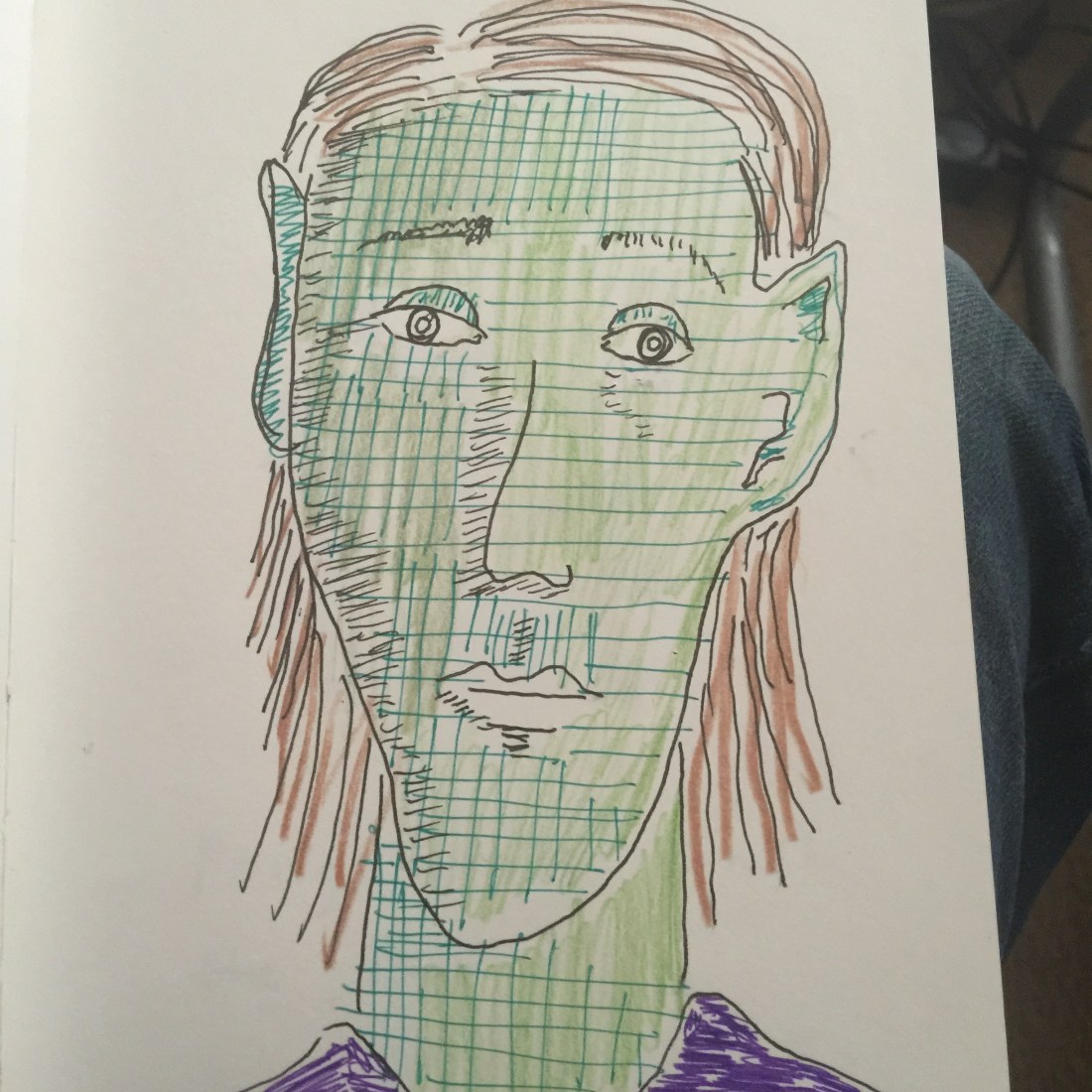
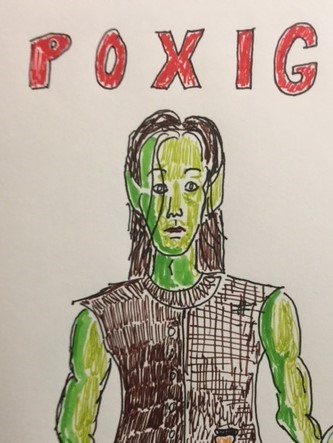
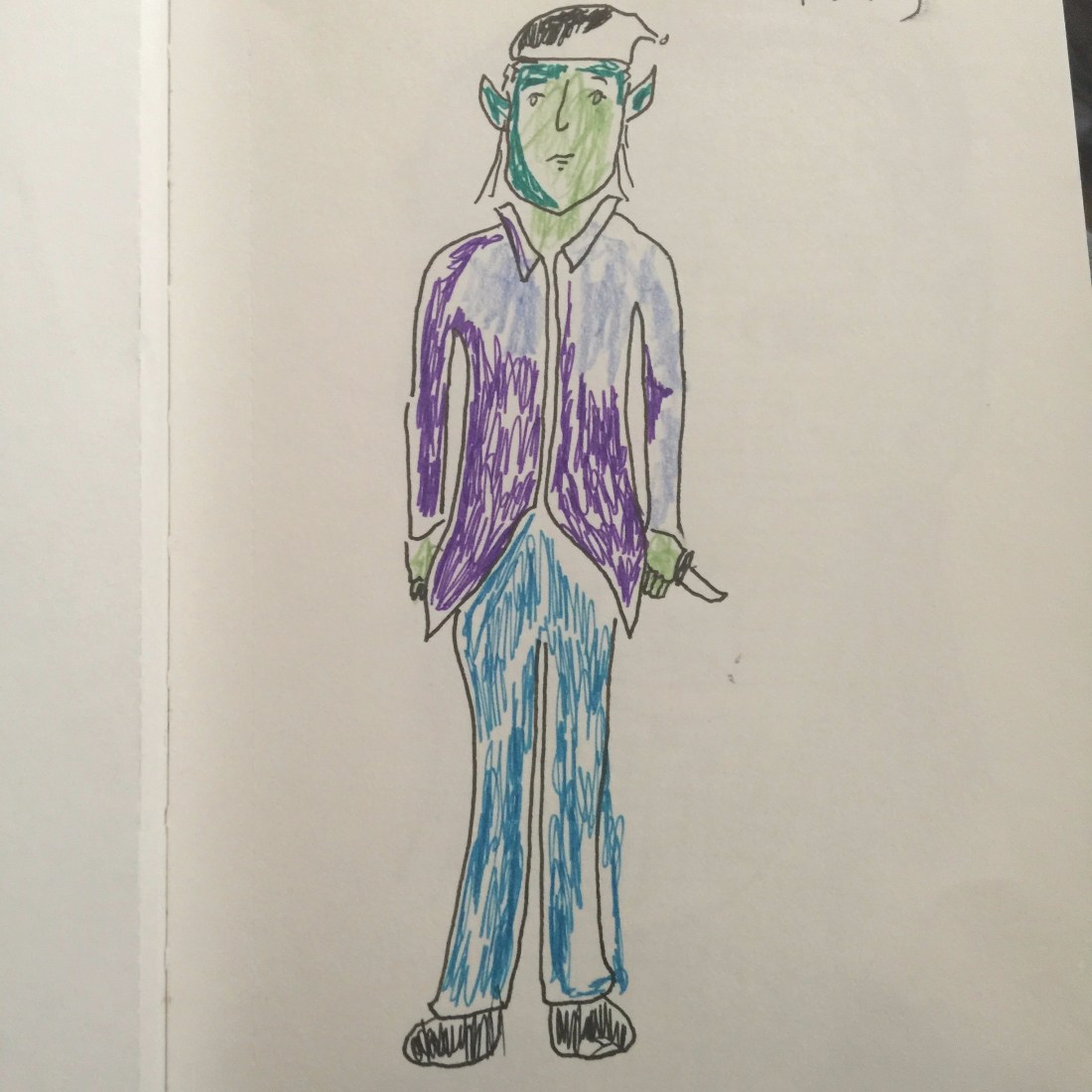
Poxig is based on my son, Gabe. As understood from the prequel of the adventures of Poxig, he is a troubadour of sorts. Indeed, my son is also pretty good with a guitar. Of course, he loves baseball more, but Poxig lives in world in which baseball would be anachronistic. In all honesty,  these perfunctory literary efforts are all dedicated to him. All illustrations are colored by him.

I was reminded that a great vocabulary is the hallmark of an educated person. This is essentially true of the misanthrope, as well as the scholar. I only wish that my son would develop a better vocabulary, and that is the focus of my literary efforts. It is understood by most parents that it is always a work in progress. I would definitely concur.

Any parents out there know that we imagine heights that our children may never reach. But that does not mean that we shouldn’t dream.  It just means that as they grow up, we should prepare them  for reality as best we can. That magical time which is called adolescence should be a time of character development. These are tender years, nonetheless.

ESL journeys

cartoonI’m taking a break from our regularly scheduled programming to make a few insightful comments about teaching ESL.

Erving Goffman once wrote: “Not then, men and their moments. Rather, moments and their men…” (Goffman, 1967) I wholeheartedly concur with regards to teaching ESL.  Any day, you never know what semantic rigmarole you are going to get involved in.

In grad school, I had a great teacher named Carolyn Fuchs, and she always said that prescriptive grammar has its limits in the ESL classroom. Better to be descriptive rather than prescriptive. Better to do bottom-up rather than top-down instruction.

I’m not sure this is always the best approach, however.  There are some times when the students are just not saying anything. Many or most of Asian learners are going to be in the silent period for a while, and that has a lot to do with the fact that they were subjected to top-down for a considerable period of their education. (No one can argue that the scarves that Chinese girls must wear to school is aimed at having them express their individuality!)

So back to Goffman, the teacher is merely a conduit for the moment.  It is not about “him” or “her” exactly. It is trying to create the right moments for learning. And all of the lesson planning is going to try to make the right conditions for that. Like building a fire, it is better to get kindling to set it ablaze. You have a better chance  at getting a roaring fire that way. You just really can’t shove the lesson plan down the students’ throats. (If it isn’t working, it isn’t working.)

Some of my readers may wonder why I think there is any overlap between  my comments on “eslteacher576” & YA fiction. Actually, I think this stuff stimulates the creativity that is so vital in the classroom. If not for them, then at least for me. I am well-aware that it is not about me. It is about student learning. I am often humbled with how little I can actually get my students to do.

If there is any takeaway, this is it: “Methods mork; teachers work.” Unless you’re ready to put in the work, the results are going to be harder to get.